When Learning Breaks: A Human Systems View of Education Failure
An ordinary moment can reveal a much bigger story. From my home in Mediterranean Spain, I explore how global systems meet everyday life—and how culture gives those encounters meaning. A café conversation, a university classroom, a neighbourhood…
When Learning Breaks: A Human Systems View of Education Failure
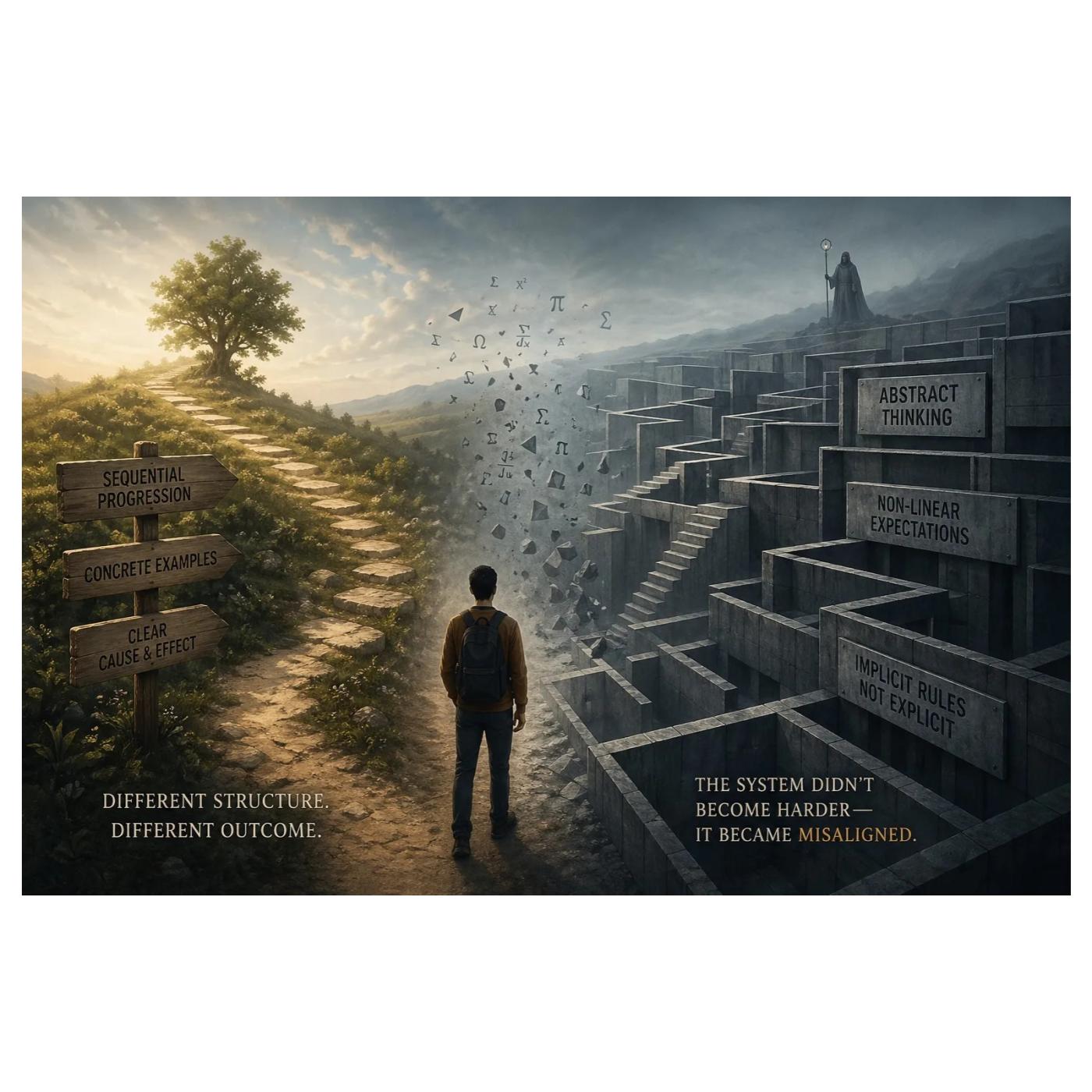
When someone succeeds in one learning structure but fails in another, the issue isn’t ability—it’s alignment.
In this episode, I share my experience attending around ten colleges and universities, earning two associate degrees, and repeatedly encountering the same pattern: success at structured, sequential levels—and breakdown at abstract, non-linear ones.
This isn’t about effort or intelligence.
It’s about how systems are designed.
Key ideas:
- Learning systems don’t just get harder—they can become misaligned
- Accommodations don’t fix structural mismatch
- Abstract models often exclude valid ways of thinking
- Failure patterns often reflect system design, not human limitation
If learning breaks, the better question isn’t “what’s wrong with the person?”
It’s: what changed in the system?
Category: Human Systems Tags: human systems, learning design, cognitive systems, education, decision guidance
Human Systems with Oddly Robbie
An ordinary moment can reveal a much bigger story.
From my home in Mediterranean Spain, I explore how global systems meet everyday life—and how culture gives those encounters meaning.
A café conversation, a university classroom, a neighbourhood tradition, or a frustrating piece of paperwork can open a question: why does this work the way it does? What shaped it? And why might it feel perfectly natural to one person and puzzling to another?
I’m Robbie Ellestad, also known as Oddly Robbie. After living in 22 places around the world in three years, I’m staying long enough to look more closely.
Human Systems connects personal experience with wider patterns in technology, history, economics, and human behaviour. I follow the connections, question my assumptions, and look for those “ah, now I see it” moments that change how we understand something familiar.
Rooted in life here. Curious about what connects it to everywhere else.
(Oddly Robbie is just something I do for fun. I don’t accept donations, sponsorships, paid promotions, or other compensation. It’s a hobby, not a business.)